By Gabriel J Gonzalez
Tue, Nov 10 2026
Texas Boxing Judging Under Fire Again After Controversial Ramla Ali vs. Mikiah Kreps Decision
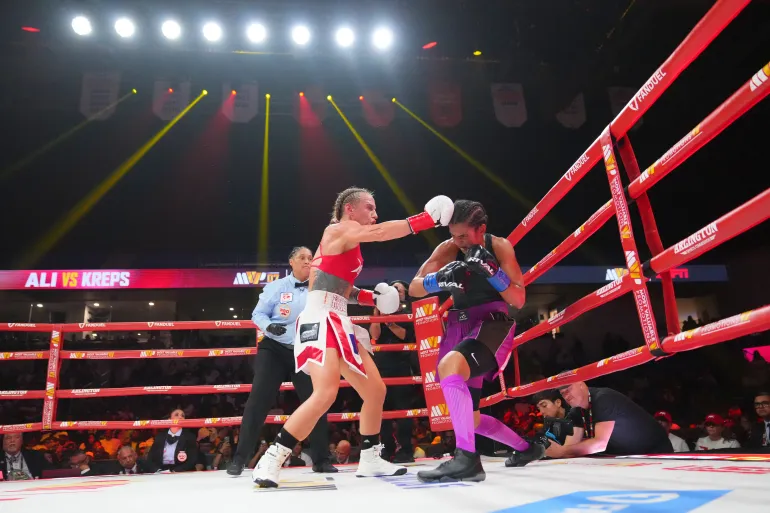
Texas has developed an unfortunate reputation for controversial boxing decisions over the past two decades. On Sunday night, November 8, 2026, that reputation took another hit when undefeated American Mikiah Kreps suffered a highly questionable split-decision loss to Ramla Ali in Arlington, Texas.
What should have been the crowning moment of Kreps’ professional boxing career instead became another chapter in the long history of disputed Texas scorecards.
Fighting for the vacant IBF and WBO super bantamweight world championships at College Park Center, Kreps appeared to outwork, outland, and outfight Ali for much of their ten-round contest. However, when the final scorecards were announced, it was Ali who walked away with both world titles.
The judges scored the contest 97-92 and 96-93 for Ali, while the third judge saw a completely different fight, scoring it 98-91 for Kreps.
A seven-point victory for Kreps on one scorecard and a five-point victory for Ali on another. How can three professional judges watching the same fight see such drastically different results?
Unfortunately, for boxing fans familiar with the sport’s history in Texas, this wasn’t anything new.
Mikiah Kreps vs. Ramla Ali: A World Championship Controversy. Entering the contest with an undefeated 11-0 record, Niagara Falls, New York native Mikiah Kreps was competing for her first professional world championship.
The former amateur standout, who earned a bronze medal at the 2019 World Championships, had spent years working toward this opportunity. Ali, a former Olympian representing Somalia, entered the fight with an 11-2 record and was looking to capture her first world championship.
The fight began competitively, with Ali finding success early. In the third round, Ali landed a right hand that stunned Kreps where her right glove brushed the canvas giving her a crucial 10-8 round. However, Kreps recovered and began taking control of the fight through relentless pressure, combinations, and an impressive work rate. As the rounds progressed, Kreps continued pushing forward, forcing Ali onto the defensive and consistently landing punches to the head and body.
According to CompuBox statistics:
• Total punches landed: Kreps 115, Ali 78
• Power punches landed: Kreps 91, Ali 70
• Rounds with more punches landed: Kreps led in eight of ten rounds.
While punch statistics alone do not determine the winner of a boxing match, they provide additional support for what many observers believed they witnessed. Kreps was the more active fighter, controlled much of the action, and appeared to do enough to earn a clear decision. Instead, judges Melva Santos and Lisa Giampa awarded the victory to Ali, while Nexis Novoa scored the contest overwhelmingly in favor of Kreps.
The decision immediately sparked criticism throughout the boxing community. Veteran boxing promoter Lou DiBella was among those questioning the outcome, stating publicly that Kreps had clearly won the fight. X, formerly known as Twitter, exploded in anger with most people calling it a robbery. If that wasn’t enough, a widespread video of Shakur Stevenson and Caroline Dubois’s reacting to the decision said it all with Stevenson shaking his head at the result.
Even more troubling is what the decision potentially cost Kreps. Beyond suffering the first defeat of her professional career, she lost the opportunity to become a unified world champion and potentially secure future championship opportunities and larger paydays. For a fighter who spent years preparing for this moment, the consequences extend far beyond a single loss on her record.
Texas Boxing Judging: A History of Controversial Decisions
The Kreps-Ali controversy is hardly an isolated incident. Texas has hosted numerous major boxing events over the past 20 years, several of which ended with decisions that left fans, fighters, and boxing journalists questioning the judging. In fact, it wasn't even the fight of the night. The Natalie Dove vs Nayelli Rodriguez fight ended in controversy, and the Sims-Patricio fight turning in a disgusting 100-90 scorecard in a fight where both fighters went back and forth all night long.
Here are four notable examples.
1. Tavoris Cloud vs. Gabriel Campillo — February 18, 2012
One of the most notorious disputed decisions in recent Texas boxing history occurred in Corpus Christi when Tavoris Cloud defended his IBF light heavyweight championship against Gabriel Campillo.
Despite suffering two knockdowns in the opening round, Campillo recovered and appeared to dominate much of the remaining fight. Many boxing observers believed Campillo had done more than enough to secure the victory. Instead, Cloud retained his championship by split decision, with judges scoring the fight 116-110 and 114-112 for Cloud, while the third judge favored Campillo 115-111. The decision generated widespread criticism and became another example of questionable scoring in Texas.
2. Juan Diaz vs. Paulie Malignaggi — August 22, 2009
Perhaps one of the most infamous examples of controversial Texas judging occurred when hometown favorite Juan Diaz faced Paulie Malignaggi in Houston.
Malignaggi used his boxing ability, movement, and jab to frustrate Diaz throughout the contest.
Although the fight was competitive, many observers believed Malignaggi deserved the victory.
Instead, Diaz was awarded a unanimous decision. The biggest controversy involved judge Gale Van Hoy, who scored the fight an astonishing 118-110 for Diaz. The scorecard was so questionable that even Diaz’s promoter, Oscar De La Hoya, publicly criticized the judging. A rematch was eventually held outside Texas in December 2009, with Malignaggi winning a convincing unanimous decision.
3. Jermell Charlo vs. Brian Castaño — July 17, 2021
In another major championship fight held in San Antonio, Jermell Charlo and Brian Castaño battled for the undisputed junior middleweight championship. Castaño appeared to control significant portions of the contest through pressure and combination punching. However, the fight ended in a split draw. The most controversial scorecard came from judge Nelson Vazquez, who somehow scored the contest 117-111 for Charlo. The other judges scored the fight 114-114 and 114-113 for Castaño. The six-point margin for Charlo drew widespread criticism, particularly considering how competitive the fight had been. Once again, a major championship contest in Texas ended with the judges becoming the biggest story of the evening.
4. Devon Alexander vs. Victor Ortiz — February 17, 2018
Former world champions Devon Alexander and Victor Ortiz met in El Paso in a welterweight contest that produced yet another disputed result. Alexander appeared to land the cleaner punches and control much of the fight. However, the judges returned a majority draw, scoring the contest 115-113 for Ortiz and 114-114 on the remaining two cards. Many ringside observers believed Alexander had done enough to win comfortably.
CBS Sports scored the contest 117-111 for Alexander, highlighting the significant difference between some media scorecards and the official result.
These are just a few of the dozens and dozens of examples with a fair amount being in Texas. Boxing is a subjective sport. Close rounds can be interpreted differently, and disagreements between judges are inevitable. However, there is a difference between a competitive fight producing a close decision and three judges returning dramatically different scorecards.
The Ali-Kreps fight is a perfect example. One judge believed Kreps won by seven points. Another believed Ali won by five. That represents a remarkable difference in how two experienced officials interpreted the same ten rounds. The issue isn’t simply whether Ali deserved the victory. It’s whether the judging accurately reflected what happened inside the ring. When fighters can dominate significant portions of a contest, outland their opponents by substantial margins, and still lose on scorecards that differ so dramatically, the credibility of professional boxing suffers. To be clear, controversial decisions are not exclusive to Texas. Boxing has experienced questionable judging throughout its history and across the world.
However, the number of high-profile disputed decisions in Texas raises legitimate questions about how judges are selected, evaluated, and held accountable.The sport depends on fighters believing they will receive a fair opportunity when they step into the ring, regardless of where the contest takes place.
Mikiah Kreps deserves an immediate rematch. Ramla Ali deserves credit for her performance. She scored the only knockdown of the contest, fought through ten difficult rounds, and accomplished her dream of becoming a world champion. None of the controversy surrounding the decision should be directed personally at Ali.
The responsibility for scoring the fight belonged to the judges. However, Mikiah Kreps deserves better than having her first world championship opportunity end under such questionable circumstances. Kreps entered the ring undefeated, delivered an impressive performance against a world-class opponent, and left without the championships many believed she had earned. An immediate rematch would provide both fighters the opportunity to settle the controversy and determine a clear winner.
More importantly, the Texas Department of Licensing and Regulation, which oversees professional boxing in the state, should review the scoring and determine whether further evaluation of the officials is warranted. The history of controversial decisions in Texas cannot simply be ignored every time another questionable result occurs.